 TRENDFORGE / NEW CLASS / OPENED NOVEMBER 3, 2026
Data Centers: Announced vs Real
Potential users of this record →
WHY THIS CLASS EXISTS
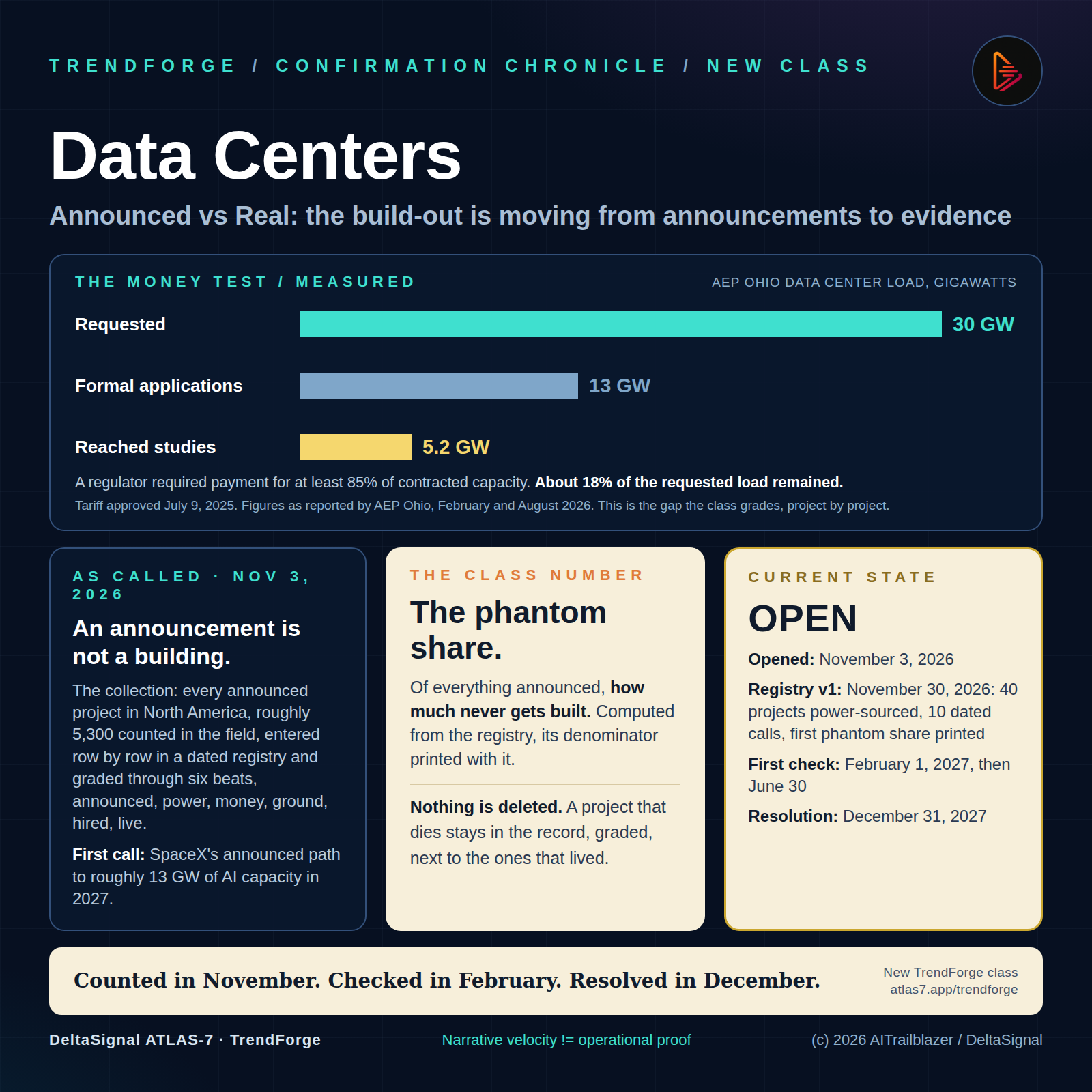
Announcements are the cheapest thing in the build-out. What a project is worth depends on how much of the announced capacity survives contact with money. One American utility has already run that experiment in public:
AEP Ohio data center load, gigawatts, as reported in February and August 2026. A regulator required payment for at least 85% of contracted capacity. About 18% of the requested load remained.
THE CHAIN
Six beats stand between a press release and a building. A project is graded on the beats it can prove, in dated records: utility filings for power, company filings for money, permits and ground evidence for construction.
FIRST CALL
Claim: roughly 13 GW of AI capacity in 2027, as announced by the company.
Called: November 3, 2026. First check: February 1, 2027. Interim: June 30, 2027. Resolution: December 31, 2027.
The call resolves on energized capacity counted from utility and company evidence only. Between markers, beat changes publish as they happen.
THE PLACE READS
Every registry project also carries a place read: the tract it lands in, resolved the way AudienceMap resolves any coordinate, with the published statistics and their survey period named. A place conditions a call; it is never evidence for one. The first three:
| Population | 5,516 |
| Median household income | $58,505 |
| Housing units | 1,477 |
| Labor force | 2,349 |
| Population | 4,277 |
| Median household income | $38,194 |
| Housing units | 1,884 |
| Labor force | 2,068 |
| Population | 1,086 |
| Median household income | $59,286 |
| Housing units | 678 |
| Labor force | 658 |
THE REGISTRY
The collection is running: every announced project in North America, roughly 5,300 counted in the field, entered row by row. The registry seeds from compelled records first: money-test dockets, company filings and disclosures, and public proceedings that name a project and its megawatts. Announced-only projects join flagged by their evidence rung.
Registry v1 stands on November 30, 2026: forty projects with power sourced and dated, ten dated calls entered, and the first phantom share printed from the registry. The first public quarterly grade, with the class hit rate scored against two naive baselines, follows at the January 23, 2027 checkpoint.
The machine behind this registry is ATLAS-7: one year in the building, and $73,000 worth of model tokens used on Azure alone, before its first call was graded in public. The tokens can be bought. The year, and the dated record since, cannot.
THE LISTS
The registry publishes as lists, one for each state a project can be in. Each list carries its count and its date; the counts print as the collection lands.
The Announced List. Every announced project in North America, the full universe, roughly 5,300 counted in the field.
The Power List. Projects with a filed, dated power position: an interconnection application, a service request, a place in a queue that exists.
The Money List. Projects that closed their money: financing signed, or a binding contract with collateral posted.
The Ground List. Projects under construction, verified on the ground, not in a rendering.
The Live List. Projects in operation, energized and serving load.
The Phantom List. Announced, and never built. Nothing is deleted: a project that dies stays on this list, graded, next to the ones that lived. The phantom share is computed from it.
Buyers do not take the lists home. They pick their names from them and buy the watch.
The list of potential users of this record →
The record lives on the TrendForge ledger.